
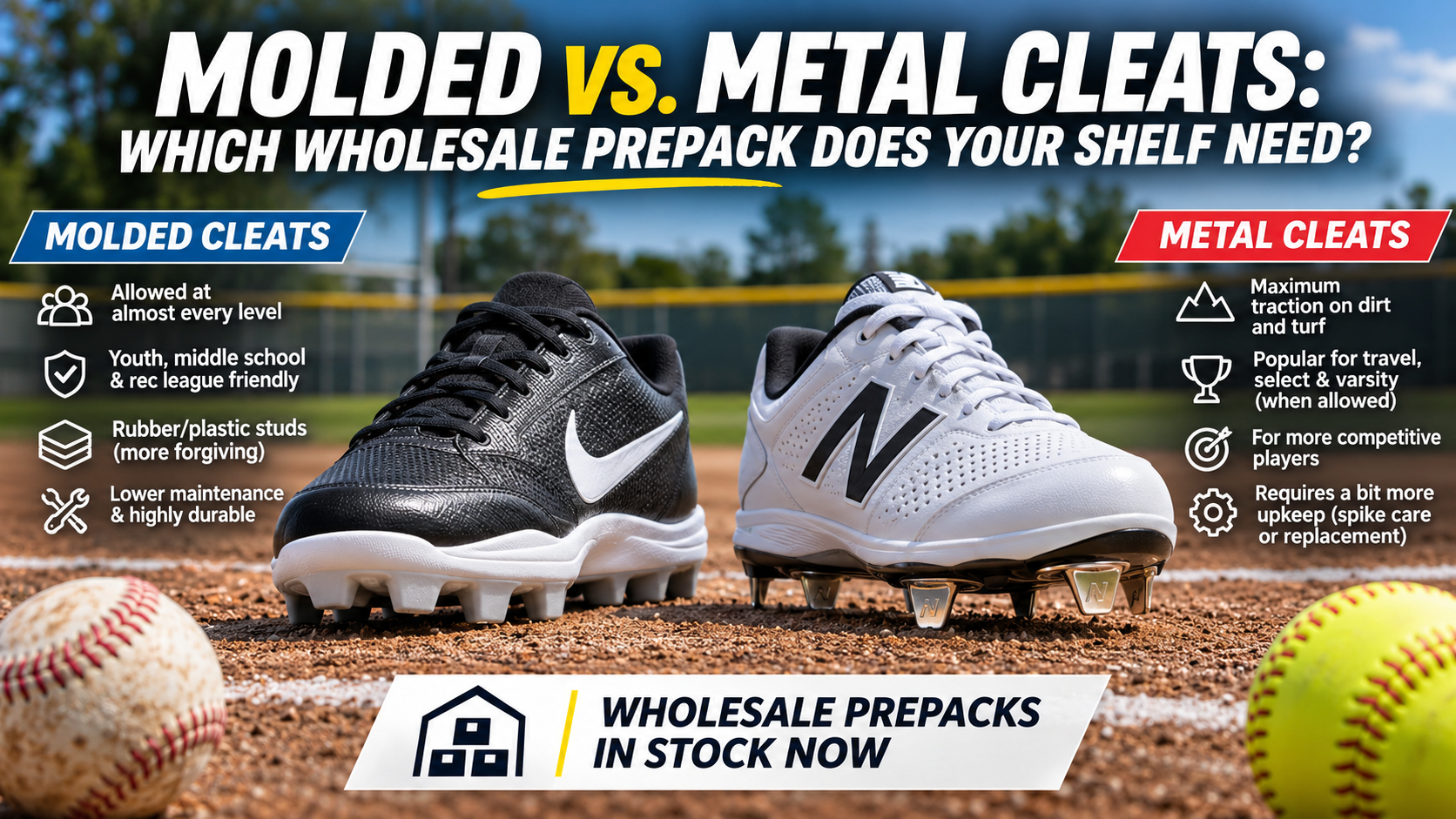
"Molded or metal" isn't a style preference — for a lot of buyers, it's a rulebook question before it's anything else. Most youth leagues, middle-school programs, and a good chunk of rec ball cap out at molded or rubber studs, while travel ball, select teams, and high-school varsity-and-up players are often the ones specifically asking for metal, because of the traction it gives on dirt that molded simply can't match. If a shop only stocks one, it's turning away roughly half the buyers who walk in before they even get to pick a brand.
That split shows up in how people actually search for these products, too. Shoppers searching "molded baseball cleats" or "molded football cleats" are usually asking a different question than shoppers searching "metal softball cleats" by name — one group is figuring out what's allowed on their field, the other already knows and is comparing brands. A shelf (or an online catalog) that only answers one of those questions is leaving business on the table.
WHY THE DISTINCTION MATTERS
Molded cleats use a fixed, non-removable sole — usually rubber or hard plastic studs molded directly into the outsole. They're legal on essentially every field, grass or turf, and at nearly every level, which is exactly why most youth and rec league rulebooks either require them outright or default to them. They're also more forgiving for players who are still growing into their footwork, since the studs are shorter and more evenly distributed, reducing the ankle-roll risk that taller metal spikes can create on uneven ground.
Metal cleats trade that flexibility for raw traction. The spikes dig into dirt infields and turf in a way molded studs can't, which is why they're the standard once players move into travel ball, select programs, and varsity-level high school and up — assuming the league allows them, which most higher levels do. For a retailer, that means metal isn't a "better" product across the board; it's the right product for a specific, usually more competitive, customer.
WHAT'S AVAILABLE RIGHT NOW
Premium Nike Molded Baseball Cleats – Adult's Prepack (28 Pairs/Box) — $27/pair, $756 for the full box. Sizes run 7–13, and the box is currently in stock and ready to ship. This is a straightforward, single-brand molded prepack, which makes it an easy add if you're filling out a baseball or multi-sport order and want a dependable, rules-safe option on the shelf.
New Balance Metal Softball Cleats Mix – Adult's Prepack (20 Pairs/Box) — we cover full pricing, sizing, and availability in our dedicated metal softball cleats guide, since that prepack has its own breakdown worth reading in full before you order.
Between the two, you're covering both ends of the molded/metal split across baseball and softball. If football or soccer is also part of your order, those sports have their own dedicated wholesale pages — wholesale football cleats , wholesale baseball cleats , wholesale softball cleats , and wholesale soccer cleats — so you're never opening a second vendor relationship just to round out an order.
WHO SHOULD ORDER WHICH
If most of your customers are outfitting youth leagues, middle-school teams, or general rec ball, molded is the safer default — it's allowed almost everywhere, and you won't field complaints about a cleat getting rejected at a game. If your customer base leans toward travel ball, select or club programs, or high-school varsity and adult leagues, metal is worth stocking specifically because that's what those players are already looking for by name, and generic molded alternatives won't satisfy that search.
Most shops serving a mixed customer base — which describes a lot of general sporting-goods retailers — end up carrying both once they've got buyers spanning multiple age groups and levels. It's not an either/or decision so much as a "which do I lead with" decision, and that usually comes down to whichever age group makes up more of your foot traffic or order volume right now.
DURABILITY AND UPKEEP DIFFER TOO
It's not just traction and legality that separate the two. Molded studs are tougher to damage in normal wear, since there's no individual spike to bend or snap off, which makes them a lower-maintenance option for programs that are rotating cleats through multiple players a season or handing them down. Metal spikes need a bit more care — they can bend on hard surfaces like concrete or dugout floors, and most players swap or tighten individual spikes occasionally rather than replacing the whole shoe. For a retailer, that difference is worth mentioning at the counter or in product copy: metal buyers are often repeat customers for replacement spikes and accessories, not just the cleats themselves, which is a small but real reason to keep metal in stock even if it moves slower than molded.
A FEW THINGS TO CHECK BEFORE YOU ORDER
Before committing to either prepack at scale, it's worth confirming two things with your own customer base: first, whether the specific leagues your buyers play in actually restrict metal spikes (rules vary by state athletic association and by individual league, so don't assume one blanket rule applies everywhere), and second, what sizes are moving fastest for you historically, since a 20- or 28-pair mixed box is most useful when the size run matches what you actually sell. Both prepacks above ship in a fixed size spread rather than a custom one, so matching that spread to your typical buyer up front saves a reorder cycle later — our cleat sizing & MOQ guide walks through how to think about that match if you're new to ordering prepacks.
WHY CLEAT WAREHOUSE?
You're not locked into a long-term contract or a subscription to order from us — reorder whenever stock runs low, and skip a cycle if you don't need it. You can also mix prepacks across sports and cleat types onto a single order and a single freight bill (see our freight policy for how that works): a molded baseball box, a metal softball box, and a soccer or football prepack can all ship together instead of triggering three separate vendor relationships and three separate shipping charges. Rounding out an order with gloves, shin guards, or other gear? Our wholesale sports accessories guide covers what's available there too. Inventory does shift as new stock comes in, so the exact brand mix inside a "Mix" box can vary slightly between reorders — worth a quick check of the current listing before you commit if an exact brand match matters for your shelf.
READY TO ORDER?
Head to the store to place an order, or message us on WhatsApp first if you want to confirm current stock and sizing before you commit.